Web Men's Flair  

Quote of the Day - September 5th, 2010 More quotes on fashion, style, and dressing...

Fashion is an imposition, a reign on freedom.
-- Golda Meir

The ‘Big’ Question

August 22, 2010 (7 Comments)

the-big-question

So fashion has relented and will now produce plus-size designs with Marc Jacobs leading the charge. I for one am not particularly surprised. For years, high-end clothiers have resisted the call, for decades they have turned a blind eye to a developed world only increasing in size and weight and for as long as they would now care to forget, they have avoided tapping into a potentially massive (no pun intended) market; considering most fashion labels are deep in debt, it was high time, the accountants warned, that they come up with a profitable idea.

Why, pray, does this concern the readers of Mensflair? Well, as little as it will affect the next few years of shirt buying or tailoring, the eventual knock-on effect of such a seismic shift in the fashion world will send shockwaves throughout the clothing retail world; other designers, except perhaps Karl Lagerfeld, will fall too. Fashion will change, and the way we look at clothing will change too.

For instance, designers will have to rethink style; designs that work on a skinny model do not work on a plus-size model. This affects both female and male design; the knock-on effect to fashion-conscious behemoths like H&M and Zara will be substantial. I think it possible that they will divide plus-size clothing from standard size clothing – take heed, all the chaps who said they couldn’t fit into “anything in that damned Spanish store.”

I also think it possible that outré fashion takes a back seat, with more variations on timeless style forming the foundation for fashion’s new audience; it may well be the death knell for outrageous couture, which is already exhibitionist PR designed to add credence to the fashion house concerned.

Many will be thinking “Big sizes? Big deal” and rightly so; anyone who sifts through the tail end of sales and reddens in fury at the proliferation of XXL and lack of a single Medium knows that ‘big’ chaps are not unfairly treated when it comes to fashion, they’re simply less interested. Vanity is the product of favour; it is more common in people who are of a more conventional size. Although in fairness, larger people have been excluded from the ‘ideals’ paraded by fashion, which is down mostly to the fact that they do not match the aesthetic ideal of fashion’s nonpareils, minutely because of the health risks of endorsing size – fashion PR would have you believe it is entirely the latter.

The question is, does this signal the end of the fashion world as we know it? Are those hallowed houses, constructed on the dubious foundations of anorexia, bulimia and Adobe Photoshop to come crashing down? As long as vanity multiplies at the rate it does, I doubt it. I see more of an evolutionary wisdom in fashion’s nod to this ‘growing’ market; they may not be scientists, but they see the divisions in humanity already forming, however slight they currently appear.


Leave a Comment


The Evening Dress Shirt Should Be Fitted

August 20, 2010 (6 Comments)

fitted-evening-shirt

Flash photography can be cruel. I always smile, compassionately I might add, when friends take me through photos of “an amazing venue” they visited, only for the flash to utterly corrupt the memory by blanching the closest object and blackening the background; “Damn” my friends exclaim “it was a lot nicer than this, I swear!” The fact is, I have no doubt that it was. Flash has the capability of flattering faces, by accentuating angles and brightening eyes, but it utterly destroys everything else, including clothing.

Anyone who has been photographed with a simple point-and-shoot flash camera will attest that the results were nothing like that which they had expected; the lapels shined supernaturally, the black wool looked slightly grey and the shirt crumpled like a pillowcase. Slick? Hardly.

I recently spoke to a gentleman who wanted to dress smartly but didn’t want to have to worry about his clothing; “I don’t want to go into a meeting and be worrying about my sleeve length or anything like that. I want to look good and concentrate on the matter at hand.” His answer of course, is tailoring and it is also the answer I would supply to anyone rethinking their evening dress shirt.

Slim fit or tailored fit shirts are a better choice for evening dress because they are tauter across the torso; standard fit shirts, particularly for gentlemen not accustomed to wearing waistcoats, can often billow and bulge as the evening wears on, distracting the eye from a beautifully finished jacket or a roguishly tied bow. As uncomfortable as it sounds, a tighter fit is always to be desired in an evening shirt.

However, it is not always possible to find off-the-rack evening shirts with darts to fit one’s torso. Therefore, a gentleman should look upon a made-to-measure evening shirt as an important investment. Despite costing significantly more, a made-to-measure shirt has distinct advantages over the off-the-rack. Firstly, and most importantly, it will always fit better. A made-to-measure shirt is made to fit your singular contours; the length is exactly right, the width is exactly right, the sleeve length is faultless and the collar sits up perfectly. Crucially, the torso does not bag, sag or crumple; it is placidity itself, a mill-pond of a shirt.

Secondly, a made-to-measure shirt is much more comfortable than squeezing yourself into a slim fit for the sake of it. Gentlemen who experience a discomfort with slim fit shirts can direct the tailor where the discomfort is and how, considering that the exposed Marcella torso should be as taut as possible, any tailoring can avoid such discomfort.


Leave a Comment


Brown Suede Shoes And Suits

August 19, 2010 (1 Comment)

brown-suede-shoes

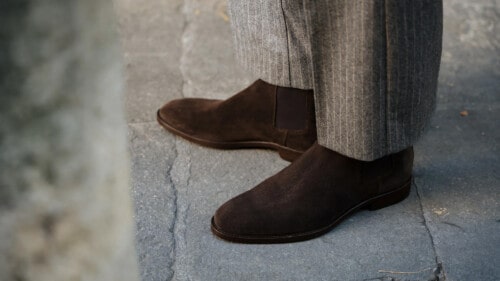
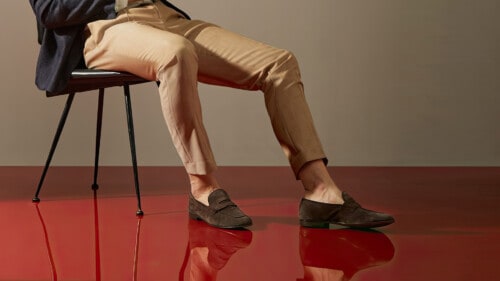
There is a long tradition in England of men wearing brown suede shoes with suits, in particular blue shirts.

In fact my first encounter with the look came as a young shop assistant when a wonderfully irreverent and sprightly old Cavalry Colonel came in to buy a black umbrella. There was to be a parade of veterans that day in front of the regiments Honorary Colonel, Princess Ann; and “the General” had ordered him to buy one. After parading up and down the shop a few times to get the feel of his new brolly he departed a happy man.

Ever since that encounter brown suede shoes with blue suits have been a staple look in my inventory, and I’m far from alone.

The most notable advocates were of course the Duke of Windsor and later Carry Grant. But as I highlighted in my post about Terry Thomas, they became a signature of his dress also. Thomas took his inspiration from actor Sir Gerald du Maurier who was popular in the twenties and early thirties, before his life was cut short by colon cancer in 1934.

But just where it started is a mystery and one I’ve been trying to solve for some time. The Duke of Windsor is often given the credit for making brown suede and suiting popular, but the look, as with wearing military stripe ties, predates the man himself.

I’m far from there, but it seems it may not be the acting fraternity or Royalty we have to thank, but the British Army.

Referring back to our retired Colonel, you might think that such a man on such an occasion would have worn black oxfords. But historically it has been the practise within the British Army that officers wore brown shoes and boots while enlisted men wore black. And it may be that this differentiation of class and rank has its part to play. Of course this doesn’t entirely explain the use of suede.

The House of Common has its share of sartorialists. With one in particular I’ve enjoyed many a chat about matter of dress. Patrick Mercer is an MP, former Colonel, successful author and happens to be a member of the suede shoe fraternity. His theory is that during the 1920s and 30s it was popular for British Army Offices loafing around in the Middle East to wear suede dessert boots on and off duty. These were not the ‘Clarks’ desert boots we think of today, but a more formal robust boot. He believes this footwear trend returned with officers to the UK, and this would certainly fit the time frame.

I’m not convinced this is the definitive answer, and so my search continues. But if anyone knows better I’d be delighted to hear your version.


Leave a Comment


Beyond The Pale

August 18, 2010 (5 Comments)

beyond-the-pale

A gentleman wakes on an average, overcast morning. He performs his toilet, selects a suit from his wardrobe and flicks through his shirts for a suitable choice. White is the colour of choice for our hypothetical gentleman, simply because it is the default of the masses; were he to select a French collared check shirt, he would have no relevance to the majority. Then he sets about choosing a tie. He opts for a pale yellow plain weave silk, completes a Windsor knot and then turns from his mirror toward the door.

What is wrong with this? Well, not a lot. Something which the masses would echo, en masse I have no doubt. However, when he catches a reflection of himself in a shop window on his way to the office, he notices something rather peculiar; he doesn’t appear to be wearing a tie at all.

His tie is so pale, that from a distance, and in low light, it simply merges with the white; this contrasts sharply with the darkness of his charcoal suit (again, the choice of the masses) and creates a rather odd separation of the ensemble; the suit and the shirt and tie are not in concert, indeed they are not even in the same society. This, I have noticed, is a common problem.

As a style touch, when shopping for neckwear a man should always know there is life beyond the pale.

Darken your tie

If a white shirt must be worn, darker ties will always look smarter than paler ties because they are more restrained, more ‘Monday morning.’ It is possible to pick up some very attractive and discreetly patterned darker ties that flatter not only the white shirt, but the charcoal suit it is worn with; the ensemble appears connected, sober and mature.

A little pattern

When wearing a plain shirt, a little pattern goes a long way as far as neckwear is concerned; don’t follow the politicians with their PR-friendly Lego ties, go for a polka dot, a club stripe, or a foulard.

Go shirt shopping

There is nothing wrong with pale ties. They are certainly brasher than darker ties, so you must be careful where and when you wear them but also, what shirt and suit you wear them with. A cornflower blue is a better companion for a yellow or a pink tie than a white, so stock up on some saturated shirts.

A warning about matching

Resist the urge to match the pocket square to the pale tie. This creates a ‘modern morning dress’ effect and destroys the seriousness of an ensemble; not ideal for client meetings where dignified concern is required. The tie shouts loudly enough on its own. Lower the volume by selecting a more subtle square.


Leave a Comment


A Stylish Movie: To Catch A Thief

August 17, 2010 (7 Comments)

tcat-collage

To Catch a Thief (1955) is an Alfred Hitchcock classic starring Cary Grant and Grace Kelly. Grant plays the roll of John Robie, a jewel thief nicknamed “The Cat” who has retired to the French Riviera. Following a series of jewel thefts in the area, Robie becomes the prime suspect and must prove his innocence by catching the thief.

To Catch a Thief is full of great clothing. Even the cops wear double-breasted suits. The movie was nominated for the 1955 Academy Award for costume design. While watching the movie, I paid particular attention to Grant’s wardrobe.

The movie opens with Grant in a round-necked pullover with blue and white horizontal stripes, a red and white polka dot silk around his throat, a pair of gray wool pleated trousers, brown loafers and light gray socks. I noticed a minor continuity error a few scenes later; Grant was in the same outfit sans socks.

Later in the movie Grants wears an outfit with similar elements. He pairs a heather-gray pullover with light-gray pants. The silk at his neck appears to be a paisley pattern of dark fall colors like rust, navy and dark green. His hair is sleek and shiny. Maybe Brylcreem?

One notable scene supports the assertion that a gentleman should carry two handkerchiefs. The first is for display in the jacket’s breast pocket, and the second is for personal hygiene (one for showin’ and one for blowin’). After a passionate kiss between Grant and Grace Kelly, Grant uses a white handkerchief produced from the trouser pocket of his tuxedo to wipe the lipstick from his lips. Meanwhile, a white pocket square appears angled jauntily in the breast pocket of his shawl-collared tuxedo jacket.

In my favorite outfit from the movie, Grant wears a light bluish-gray jacket with patch pockets and gold buttons. Interestingly, the jacket sports only two sleeve buttons. Also of dubious note is the fact that in one scene Grant fastens all three of the jacket’s buttons. The jacket is paired with light gray pants, a white dress shirt with button-down collars, a navy cravat with small white dots, and brown tassel loafers.

For some classic sartorial inspiration I recommend you watch To Catch a Thief.


Leave a Comment


 Page 4 of 265  « First  ... « 2  3  4  5  6 » ...  Last » 

SUBSCRIBE
Latest Articles Via Email:

Delivered by FeedBurner
Men's Flair on Facebook Men's Flair on Twitter Men's Flair RSS Feed
COLUMNS
Permanent Style (by Simon Crompton)
Ruffs, Cuffs and Farthingales (by Winston Chesterfield)
BespokeMe (by Andrew Williams)
Simply Refined (by Stephen Pulvirent)
A Southern Gentleman (by Andrew Hodges)
Smarter Style (by Michael Snytkin)
SPONSORS
RECENT COMMENTS
  • Jonny G Hughes: Excellent article. I was...
  • keithc2608: Good article and it reminded me...
  • Heath: I too am a fan of tie pins, though I...
  • Kurt N: Wearing one’s tie pin askew...
  • Rip: I AM a fan of Mad Men, but I began...
POLL
Tying a sweater around neck 'look'?

Love
Hate


View results
Archive