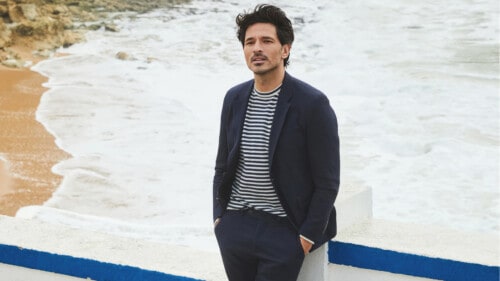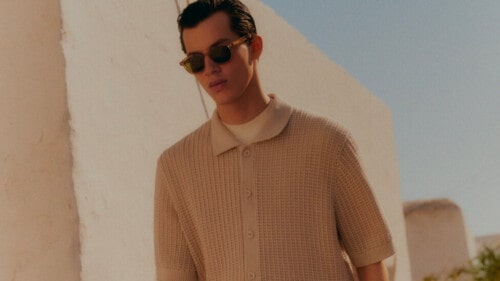
Quote of the Day - July 3rd, 2009 More quotes on fashion, style, and dressing...
-- Giorgio Armani
Short, Cropped or Rolled – A Trouser Issue
I’d like to unambiguously state that I firmly believe the shorter trouser has a place in the well-dressed man’s wardrobe. For those who have not skipped along to a different article in dismay and disgust, allow me to explain myself further:
Some time ago, I was gifted a tiny, charming and wordless book of detailed illustrations entitled An Edwardian Holiday, by John S. Goodall, which details the seaside vacation of an aristocratic brother and sister with their parents. Say what you will about the society of the time, but the era marked the flowering of the styles and standards of clothing that some of us now hold dear. And chief among the gentleman’s looks of the tome was a light blue sportsjacket, a black necktie, white laceups and cuffed light grey trousers that ended on top of or half an inch above the shoes, revealing more than a sliver of black sock. It was rather youthful, and, more intriguingly, right “on trend” in both today’s parlance and fashions. I’d wager that for most, the look is more closely associated with the greasers of the 1950s (of course, the same decade that gave us the Teddy Boys), the punks and skinheads of the 1970s, and the post-mod hipsters of the 21st century.
But some connoisseurs of tailoring that I’ve observed via style blogs are rather fond of the “no break” look, with the daring amongst them taking even more audacious steps to show a little ankle. As the summer sun draws near, it’s time to consider a little change to one’s hems to bear the warmer weather, whether on holiday or at home.

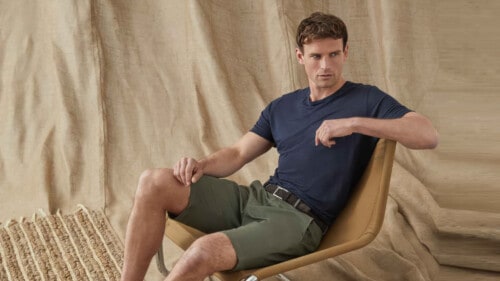
The least fussy way to go about this is to simply have a higher hem on the bottom of the trousers. This is a simple alteration for a tailor, particularly as part of a suit, and can also be achieved by purchasing a pair of trousers with a shorter leg length. The length will really depend on the purpose of the trousers. In a more casual suit, leaving an inch off the shoe emphasises a more relaxed, moddish and whimsical nature, especially if paired with a sock choice that might garner commentary on its own. With a pair of odd trousers, particularly denim, cotton or linen for the upcoming summer, two inches is entirely suitable for the sockless look and neatly avoids the “manpris” trap that would put most men off more adventurous trouser lengths. Done right, the effect will be much more prime Michael Jackson than wacky old Pee Wee Herman.
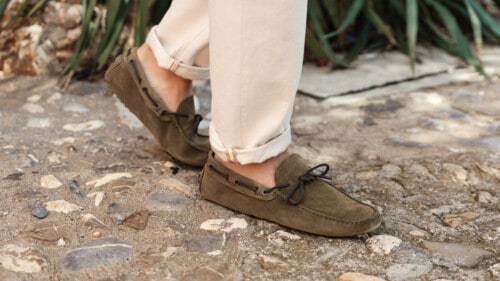
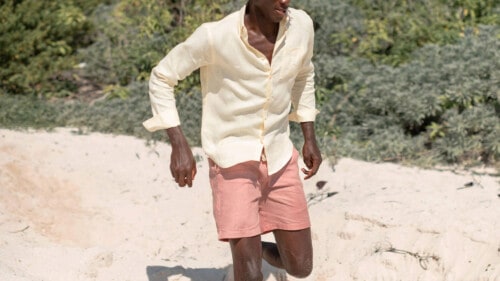
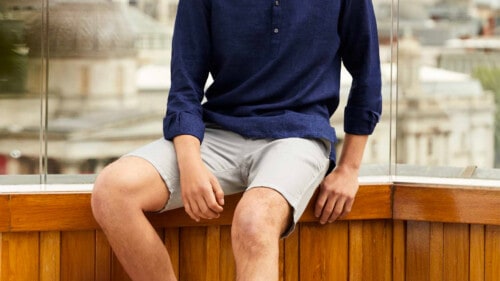
The more affordable, and presently more familiar, method of achieving the cropped look is a simple roll of the hems to create adjustable trouser “cuffs,” a much more versatile and manageable approach all round. This has the added benefit of an even more casual and less calculated aesthetic, as well as avoiding the pitfall of “too short trousers” accusations and appearing as a practical response to the heat. The style is usually done with jeans and chinos, and while not necessarily advisable with formal trousers, can be possible if the trousers are already cuffed. The look can be successful with or without socks and works best for gentlemen when dressed down with linen shirts and panama hats.
As far as widths go, a figure-hugging look can appear either idiosyncratic or overly feminine and wide legs would seem somewhat comical due to their expanse, so it’s best to wear trousers that fall straight down towards the ankles. To avoid or minimise any punk associations, one can opt for desert or Chelsea boots, while shoes such as sturdy brogues (Tricker’s, Alfred Sargent), loafers (say, Crockett and Jones or Bass), deck shoes and plimsolls should suffice for the more low cut-inclined.
A little seasonal inspiration may just be the lift one needs for summer elegance.
This is guest post by Barima Owusu-Nyantekyi, a freelance copywriter, marketer and researcher living in London. He is also an observer of popular culture, popular music and personal style who always dresses for dancing. His musings may be found at Style Time (barimavox.blogspot.com)
Leave a Comment
Links: Wearing A Hat, Summer Weekend, Sailing Bags…

• What makes a man wear a hat? (bbc.co.uk)
• Gentlmen’s wear on a weekend day. (asuitablewardrobe.dynend.com)
• Need a sailing bag? Here’s one that’s roomy, built well, waterproof and stylish. (offthecuffdc.blogspot.com)
• Tool kit for stylish repairman. (wearethemarket.com)
• Modern mods and their scooters. (bespoke-me.blogspot.com)
• Perfect jacket for modern mods on their scooters. (swipelife.com)
• Traditional East Coast look staple: J. Press ties. (acontinuouslean.com)
• Among online stores FM Allen has best Father’s Day gift ideas. (fmallen.com)
Leave a Comment
Reader Question: Reiss And Made To Measure
Thientai: I live in London and never have a chance to get a proper suit. With a tight budget, I can’t afford bespoke, but am quite interested in made-to-measure etc.
The other choice is of course, off the peg. So I browse high street stores a lot, and carefully observe their cutting and materials. One brand strikes my interest, which is Reiss of London. Their suit style seems sleek and contemporary. However they don’t come cheap. I wonder what do you think about their fabric materials and overall quality of the suits. With my lack of expertise, I want to make sure that my hard-earned ÂŁ400 is worth it. I probably need to do quite a lot of alteration afterwards.
If you suggest their quality doesn’t match the asking price then would it be better to go for, say, A Suit That Fits?
Thientai, a few words first on my experience of Reiss and then some general advice on made-to-measure.
Reiss suits are great, but they are overpriced. I have a two-button suit in brown flannel that I bought a few years ago and it has lasted very well. The material is of good quality and the handiwork has stood up well to a fair amount of abuse and dry cleaning.
I think the biggest advantage of Reiss suits, however, is the individuality of their materials and attention to detail. The brown flannel of my suit is so dark it looks like charcoal to some eyes – definitely dark rather than milk chocolate. I have never seen another wool like it. Equally, friends have Reiss suits in some fantastic checks (large-scale but faint red and green, for example) and there were a few in subtle proportions of mohair recently that caught my eye.
On the detailing, my suit has some very fine pick stitching around the lapels and beautifully rich mid-brown buttons. Others I’ve seen have experimented with mother of pearl. And I notice that this season the brand has brought out lines with my favourite double-breasted design, with just the two buttons across the waist.
The suit pictured is made with 27% mohair, jetted pockets, side adjustors on the waist and only a half-lining. All of these serve to create a crisp, light and uncluttered design.
But Reiss is overpriced (this suit is £395). Everyone I know would say the same, men and women. So if you’re going to get a suit from there I recommend waiting until the summer sales, or visiting one of their discount outlets (such as that in Bicester Village).
As to whether to go for Reiss off-the-peg (altered, as you say) or a company like A Suit That Fits, I think the choice is between material and fit. The Reiss suit will never fit as well as one that has been made for you, but I do rate the materials at Reiss more highly. I would put fit above material but I understand why others do not.
Leave a Comment
Double-Breasted: Harmony v. Balance
I read a discussion recently between sartorialists on whether a double-breasted suit should have cuffs on the trousers or not. Of course there were some declarations about it being a rule that they should, but as with all rules they are subjective and vary geographically. The important thing is to understand the reason behind the rule.
[If you haven’t read them already, you can hear my views on similar rules such as wearing brown in town, white after Labor Day and trousers without a break.]
Having trouser cuffs fits the aesthetic and tradition of a double-breasted suit; it creates harmony. Not having cuffs balances this tradition with something cleaner and more modern; it creates equilibrium. It’s up to you which you want.
A double-breasted suit is generally perceived as being more old-fashioned, and as a result worn by older gentlemen. It is also perceived as being more serious and business-like, particularly in a pinstripe. I’m not saying I agree with these perceptions, but they exist.
And, as with many questions of style, how an outfit is perceived (by either lay or stylish men) is central to its success, whether people admit it or not. A trend is merely a question of mass perception, and propriety, after all. Even if that trend lasts 20 years.
A double-breasted suit is also more bulky than a single-breasted suit and less flattering for shorter or broader men. This is not a question of perception. It is rational: the more horizontal lines and breaks in the material there are, the more the impression of height is lost.
So the question of whether to have trouser cuffs with your double-breasted suit (or which one to buy, for those without access to bespoke) could be rephrased as whether you want to match the aesthetics of the jacket to those of the trouser.
A young man buying his first double-breasted suit would probably not want a six-button jacket and cuffed trousers in a navy chalk stripe. He should go for a slightly more modern version of that ensemble – in a herringbone, perhaps, with four or even two buttons. Yet the chalk stripe might be the objet du désir for a man 10-years older, with a penchant for grandfather clocks and upholding tradition.
Equally, you might feel that you want to find balance for a very traditional shirt and tie (a contrast collar and knitted spot tie, say) with more modern aspects to the suit. Or you want an ultra-traditional suit because the handkerchiefs will be rather wild. The picture above is of a relatively conservative cut (and cuffs). But the shirt, tie and other accessories are certainly not.
Don’t be bound by the rules. If you understand them they will break softly and pleasingly.
Leave a Comment
Remember, Leather Stretches

Shoemakers can do a lot to help you decide which size is right for you. They can feel in which places your foot is hard against the edge. They can judge the clearance at the instep by how far the laces tighten. And they can look for any slippage of your heel. In the case of Lodger, they can even scan your foot to compare the fit with different lasts electronically.
But in the end, the true arbiter of fit is you. Only you know where it squeezes, where it is loose and where it hurts.
So you need to understand how leather changes. As it is a skin, it will stretch under pressure and reform. To a certain extent it will shape to your foot. This is reduced the more seams there are – leather stretches, seams don’t. So a full brogue will adapt much less than a whole-cut.
As a general rule, then, it is worth getting the size of shoe that is a little bit small, rather than a little bit big.
I had this choice when trying on a pair of shoes recently. The size 8.5 was very comfortable, but it laced all the way up with no gap at all between the facings. So over time, I knew that the shoe would become a little loose. And the right (smaller) foot already had a very small amount of slippage at the heel. I’ve solved this problem in the past with tongue pads (see post here). But that is obviously less than ideal.
The size 8 had greater room to lace up, but was tight across the ball of the foot. Not painful, but a little uncomfortable. So what to do?
Well, fortunately I have two pairs of shoes to compare to: two Edward Greens (rebranded as Ralph Lauren), one a full brogue and one a monk strap, one in an 8.5 and one in an 9. The 8.5 took a fair amount of wearing in; it was uncomfortable for months. But it now fits perfectly and will last for decades. The 9, on the other hand, was incredibly comfortable from the start but is now a little large – it required an extra hole in the strap.
The choice, really, is yours. Sometimes a shoe will fit perfectly, but often one will be a little bit big and one a little bit small. Then you have to choose: fit now or fit later.
It is also a question of personal preference to an extent – don’t forget that. Some people prefer their shoes a little loose all the time. Think back over previous experience and try and work out which you prefer. And bear in mind that leather will stretch.
Leave a Comment
• Permanent Style (by Simon Crompton)
• Ruffs, Cuffs and Farthingales (by Winston Chesterfield)
• Smarter Style (by Michael Snytkin)
- Clinton: What is your distinction between...
- Mink B.: I appreciate this concise and...
- Winston Chesterfield: Charles Tyrwhitt are...
- Jussi: I wonder if Charlet Tyrwhitt is a...
- M Rahman: I recently came across your blog...