
Style Movie: A Room With A View

Merchant Ivory productions were some of the few films that were marketed, formally and by word of mouth, by the mere fact that they were ‘Merchant Ivory productions.’ Whereas other films would be related to as ‘the new Spielberg’, ‘that Tom Cruise picture’ or as the vehicle of some other individual of sufficient wattage, those of Ismail Merchant and James Ivory, in a similar manner to the Coen brothers, were accorded the grand respect of being referred to as a product of the producer and director – all else in the production, no matter how starry their name, were of lower billing. For it is a mark of respect, and admiration, that the creative force, and not the marketing force, should be so highly perceived; in much the same way that an eager public would flock to see ‘the new Picasso’ rather than ‘a painting featuring Picasso’s mistress.’
Artistic, brimming with beauty and unashamedly nostalgic, these productions, invariably period dramas, have offered the movie aesthete an escape from the humdrum of Hollywood. The San Francisco Chronicle once wrote that the Merchant Ivory partnership connoted a genre in itself; “stuffy, worthy, well-acted entertainment, sumptuous in its sets.” ‘A Room with a View’ is without doubt one of the most famous, and most admired, of these productions. Set in Edwardian England, boasting Helena Bonham Carter, Daniel Day Lewis, a Puccini soundtrack, a fistful of Oscars and fabulous costumes, it is a paean to the triumph of beauty over social convention.
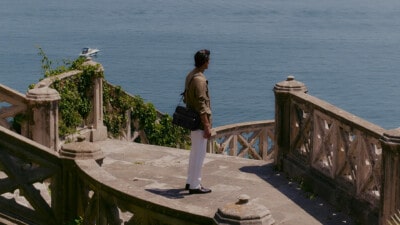
Costume plays a particularly important part in the story. The heroine, Lucy, finds herself drawn between the cultural snob and dandy, Cecil Vyse and the somewhat less refined and brooding George Emerson. However, despite the efforts of representation in the film, to convey Vyse as a cold, mirror-gazing fop and Emerson as a less decorated, more wholesome individual, it is difficult to regard all the ensembles as anything but perfect examples of Edwardian refinement. These bows and boaters mingle, as I have written before, perfectly with nature and the architecture that surrounds them. And, more than that, they illustrate so very well that, while certainly far more ornamental than gentlemen of today deign to be, that the ornament is not exaggerated, nor is the variety of ensembles without purpose or consideration of practicality or situation.
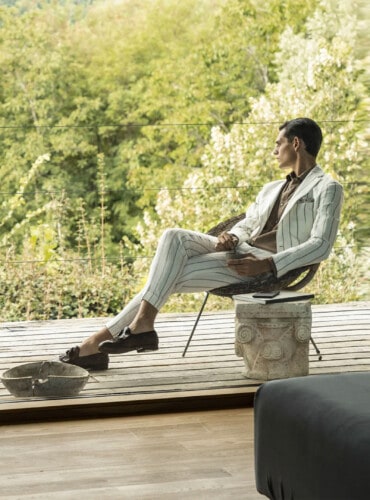
Take Daniel Day Lewis’ brilliantly insipid Cecil Vyse; though high starched collared, silk cravatted and pearl pinned, Vyse cannot possibly be ridiculed for ‘impracticalities’ of dress or ‘inappropriate elegance’ in simple surroundings. While always waistcoated, he adopts a jacket correct for the circumstance. Vyse in the Surrey summertime wears a lightweight linen jacket of casual structure when reading aloud during a game of tennis, wears a smarter white jacket to receive engagement well-wishers and when returning to town, the more formal Edwardian frock coat and bowler hat – reflecting his departure from the informality of the country. When in Italy, the gentlemen adopt lighter colours and lighter weights of fabric but never allow the temperature to alter their ensemble entirely. Even the younger gentlemen, enjoying a summer away from school, wear shirts, ties, striped jackets and cotton waistcoats.
Though invariably white shirted, the gentlemen exhibited great variety of neckwear, waistcoats, hats and footwear – is there anything more divine than a creamy white lower half in summertime? – and offered excellent reasons, both practical and aesthetic, for adopting lighter colours in the warmer months. There were also numerous reminders that wearing trousers properly, on the waist, is far more flattering than wearing them halfway down one’s legs.
Leave a Comment
Brand Review: Drakes Of London

It is always unnerving when you encounter a brand that sounds plausibly antiquated but is in fact still in its first generation. I once wrote of Aspinal of London, a company that borrowed seven of the eight letters of a famous Mayfair gambling club, perhaps in a bid to sound credibly ‘upper-crust’; a remarkably young company, considering the heritage design and appeal of its products. I was equally surprised to learn that Drakes of London, a brand that could easily have been around since the time of Queen Anne, was actually the same vintage as my parents’ marriage.
Unlike Aspinal, Drakes is not a name plucked from the top shelf of ‘England’s Most English Appellations.’ It happens to be, rather simply, the surname of the founder, Michael Drake. I hadn’t heard anything of Drakes before buzz in the style forums, and in various glossy magazines, focused on their apparently excellent online store. Famous for their ties, scarves and silk handkerchiefs, I needed little encouragement to pay a visit.
Aesthetically, Drakes is resolutely conservative. Not that this is any bad thing. I didn’t see a single tie in their collection that I wouldn’t like to own. The designs are in perfect taste, the colouring is subtle; paisleys, polka dots, stripes, foulards and Prince of Wales checks. Approving of the entire collection of neckwear, including the wonderful tartan bow ties, I moved on to scarves.
Drakes scarves ought to be their flagship items for it was the early success of their scarf sales that led the company to explore the manufacture of other gentlemen’s accessories. I liked the vast majority of the scarf stock on offer, although there were one or two that I considered a little ‘trendy’ and passé – the sort of thing you might see in a Boden catalogue.
The handkerchiefs, casually labelled ‘Pocket Hanks’ on the website (not the Forrest Gump iPhone app), are truly spectacular. The Moghul Knights and Bird of Paradise designs, “inspired by paintings from the Moghul period in design and colour” are a gorgeous example of tasteful pattern, colour and texture; 70% silk, 30% wool, they are pure pocket tapestry.
I was also considerably impressed with both the aesthetics and apparent quality of the other items in Drakes online store; beautiful cashmere shawl collar cardigans, Fair Isle sleeveless jumpers, a rainbow of socks, delicate little cuff links. Nearly every item was to my particular taste.
There was, however, one thing which irked me; a nagging irritation that dogged the pleasant tour I was making. Drakes is still slightly too expensive. I made an examination of some Drakes items at Dover Street Market and, like everything else at Dover Street Market, I considered the items overpriced.
I admire the brand for not selling out. I admire the brand for manufacturing the items in the British Isles and I am in no doubt that the items are of a rare quality, but some of the items offered, such as the £125 cotton shirt, the £125 wool scarf and even some of the £85 wool ties, are rather unrealistic in terms of price. I can also detect that Drakes realises this; “Learn why our shirts are so special”, “entirely made by hand in England”, “woven in the Scottish Borders”, “hand rolled”, “hand printed”, and various other details of manufacture that bring a tear to the eyes of every nostalgic patriot, all smack of a company trying to justify itself.
Having said that, my perspective is that of a man who has matured in the era of unsustainable disposable fashion. Drakes naked statement, which stands proud as you like against the winds of cheaply produced, disposable, ethically dubious wares, says it all; “Every day at Drakes we ask ourselves not how can we make it for less, but how can we make it better.”
Leave a Comment
Why The Fuss: The Trouble With High Fashion

It was a moment of dewy-eyed ecstasy; an elderly relative of mine, transfixed by a high definition broadcast of an expensively produced and visually breathtaking nature program. The brilliance of it seemed almost too much for a person who, in their youth, had first known television as a gigantic box with a tiny black and white screen. As they enthused about how wonderful the colours and the detail were, I considered the transformation of the format in his lifetime; from analogue to digital, from a tiny screen to a truly massive one, from CRT to LED and, crucially, from black and white to full colour.
I don’t know of a single person who longs for a black and white world. The presence of colour is one of the most fantastic accidents of life that I strive to appreciate far more than I actually do. I could see sitting next to my teary relation, who pointed and smiled with childlike joy, that the gift of vivid colour is truly marvellous. Colour is present in virtually every memory of beauty, both of celebration and regret; the bubblegum pink sunset from the terrace, the reddened tear stained cheek of a weeping child, the first blue-sky morning of Spring, a single blood red rose on a mossy gravestone.
You would think, given such treasures of inspiration, that the creatives in men’s high fashion would produce styles which reflect the gorgeousness and brilliance of colour on Mother Earth. You would assume that the vaunted corridors of the grand French houses were torrents of vivid colour; experimental clothiers excitedly dashing back and forth with garish greens, brilliant blues, rusty reds, yolky yellows, princely purples and ochre oranges, forming psychedelic arteries, feeding the colourful whimsy of fashion’s Willy Wonka. Your assumption would be presumptuous.
In fact, the houses of Dior Homme, Yves Saint Laurent and the like are so far from this bounty of colour and happiness that it makes one wonder whether their points of inspiration are not the leaden skies of London, so monotonously monochromatic are their ‘collections.’ The ‘boys’ in Dior’s recent spring/summer collection did not seem the kind of happy-go-lucky chaps who spend a weekend at their aunts in Kent, ask some friendly girls out for a punt, get sozzled on vintage champagne and then sing till the early hours in the flower beds with a view of the stars – in other words, the kind of privileged audience some fashion designers would hope to appeal to. In actual fact, they appeared more like underfed, underpaid goons from some science-fiction Orwellian netherworld where it is never sunny, where smiles are outlawed and where colour-vision has been brutally removed from every citizen’s retina.
I find it absolutely exasperating that men’s high fashion, instead of being the leading, shining example to us all of positive, beautiful and colourful expression, churns out such depressing dreck. In an age where men are permitted to ‘peacock out’, when we have long since shrugged off the infuriating sombre blackness of Victorian propriety, the ‘talent’ that reigns in some of the greatest and most influential halls of fashion fame seems intent on pushing out the same garb, entirely irrespective of season; a collection wholly composed of boring black, weary white and grisly grey.
Leave a Comment
Notes On The Advantages Of Variety

My recent article on my expansive, though scarcely expensive, shoe collection revealed that, in the balance between quantity and quality, I lean more towards the former. Deborah Carre from Carre Ducker made a good point that if I had less greed for variety, I could have purchased maybe one, two or three pairs of some outstanding handmade bespoke shoes of superior quality that would last many more years than the ready-to-wear, predominantly ‘high street’ collection that I possessed.
Whilst this is true, it is indubitably based on how long a shoe lasts for the average person. The average person, as far as I can see, does not have twenty odd pairs of shoes to rotate through, thus maintaining the ‘fitness’ of the shoes through less-than-average use. Average use, from the cursory research I conducted, is wearing a shoe every other day. My black punch cap New & Lingwood Oxfords, purchased in 2003, have lasted seven years and are far from finished; they have only been resoled once and, due to shoe rotation, look a great deal better than many others of the same vintage. Whilst the collection looks gluttonous, it is as much a lesson in longevity as in variety – and if you can have both, for a reasonable price, then what is the issue?
The same goes for suits. A large suit collection, of say 20-30 suits, sounds like gross extravagance but if you wear one everyday, proper circulation should ensure greater wear. No matter how well made a suit is, how thick a fabric, if you plonk yourself down in it, type in it, drink in it and dine in it every damn day, it will soon wear out. There is no doubt that a well-made, tailored suit will last longer than a mass-produced suit, but should you be throwing your entire collection of high street suits on eBay to purchase a single bespoke? Absolutely not. Not only is owning a single suit rather dull, no matter how beautifully it is crafted, it will not outlast you if you subject it to 365 days of wear a year. Holes will appear, fabric will fray; suits, like shoes, need a break if they are expected to last.
This is why I advocate the sustained increase, rather than decrease, in the variety of a gentleman’s suit wardrobe. By all means aspire to greater suits but consider living within your means above lofty expectations of quality. I recently spoke to a gentleman who purchased one Henry Poole suit in his early days as a stockbroker in the 1960s. His elders and betters, similarly attired by equivalent Savile Row tailors, were rather unimpressed, believing that they alone were entitled to march through their Bank offices in bespoke English suits. The lesson came when, his salary frozen, he was unable to purchase any other suit; his savings were gone and his profligacy a point of regret. “I couldn’t afford the suit” he said “and I ended up buying more, of course, at great expense.”
He informed me that it was only a doting father, himself a Savile Row account holder, who backed future purchases. Others, in straitened circumstances, might not be so lucky.
Leave a Comment
Shoe Collection
Back row (l-r): Brown wholecuts by Dune; black One Collection ‘Chance’ by Jones; brown One Collection ‘Step’ by Jones; black tassel loafers by Church’s; grey suede and leather two tone by Russell & Bromley; mid brown shoes by Zara; light brown Chelsea boots by Zara
Middle row (l-r): Black pointed shoes by Zara; black punchcap Oxfords by New & Lingwood; tan punchcap Oxfords by New & Lingwood; cream punchcap Oxfords by Grenson; patent shoes by Zara; black and peanut patent/leather co-respondent shoes by Dune; black canvas/leather co-respondent shoes by Dune
Front row (l-r): White shoes by TopMan; brown deck shoes by Austin Reed; oxblood double monkstraps by Nunes Correa; grey and white detail leather shoes by Zara; brown suede shoes by Nunes Correa; brown leather/canvas co-respondent shoes by Dune; brown and black leather wholecuts by Dune; patent leather Oxfords by Church’s
“Just how many pairs of shoes have you got?” they all ask when they spy me wearing a style that is making its debut. I decline to answer not because I take affront to the question but because I haven’t got the foggiest idea how many shoes I own. Do they want the numbers on the smart shoes? The leather ones? Or do they want me to include plimsolls, espadrilles and wellington boots? It was after a recent shopping excursion to the outstanding Crombie sale, and subsequent disappointment at the lack of a pair of tan tassel loafers in my size, that I decided to shine a torchlight into the unknown; there I was, ready to pay for yet another pair of shoes not knowing how many I actually owned. It is general wisdom that if you cannot readily quantify how much you have of something, you have too much.
Embarrassed by my footwear riches, I decided to sit down and count through the collection not only to satisfy myself of the actual quantity but to examine the range, to see how it had been built. I cleaned, polished and laid out twenty two pairs of smart leather shoes, all of which receive regular use. The strange setup reminded me of a photograph I had seen of the writer and celebrated dandy Nick Foulkes, sat amongst his own substantial shoe collection wearing a loud check suit, conveying a look that was an unusual mixture of apology, pride and satisfaction; I decided against replicating this mise-en-scène and left the shoes to convey what needed to be conveyed: quantity and variety.
It was somewhat strange to see all the shoes together. I had always been confident that I bought dissimilar shoes; “I don’t have” I would mutter “anything in this colour or style.” In truth, some of my shoes are quite similar indeed. It might surprise some that I, being a town-mouse, own so many brown shoes. I don’t subscribe to the ‘no brown in town’ rule as it has ceased to be relevant. Black is certainly the most traditional shoe colour to wear in the city, but considering the number of casual shoes that dominate the streets – plimsolls, All Stars and training shoes – a smart brown shoe no longer looks out of place. I noted that most of the shoes have a predominantly classical shape and style, about which I was not surprised, but I was amazed that I only owned one pair of smart slip-on shoes – a circumstance which I had attempted to adjust on my recent visit to Crombie.
I am rather glad I took the time to arrange the collection as it provides a perfect point of reference when I am considering further pairs; I know, for instance, that I have little need of mid-brown lace ups without taxing my brain or rifling through the boxes under my bed. As embarrassing as it is to own such a variety of shoes, please note that the collection pictured above does not include my seasonal range of espadrilles, plimsolls or driving shoes.
Leave a Comment
• Ruffs, Cuffs and Farthingales (by Winston Chesterfield)
• BespokeMe (by Andrew Williams)
• Parisian Gentleman (by Hugo Jacomet)
• Smarter Style (by Michael Snytkin)
- David Royce: I wish I could be more...
- Jake: I agree with you that...
- Canadian: I believe the term...
- Andrew Hutchinson: Our High Streets...
- Marina Demchuck: Hello from Ukraine ! These...