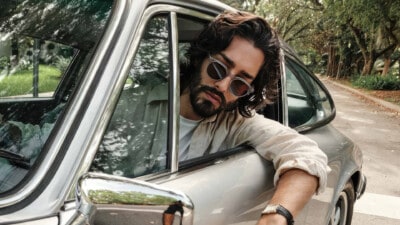
The Right Short Sleeved Shirt

My recent article on the Sartorial Love/Hate of rolled up jacket sleeves caused some decent debate about the practice. It also inspired some thought on rolled up shirt sleeves to which I pinned my colours of allegiance, at the expense of short sleeved shirts. A friend of mine noted this and asked, rather touchingly, what I had against the poor old short sleeve. I assured him it is neither the sleeve, nor even the shirt that I object to but the way it is conceived and the style in which it is worn.
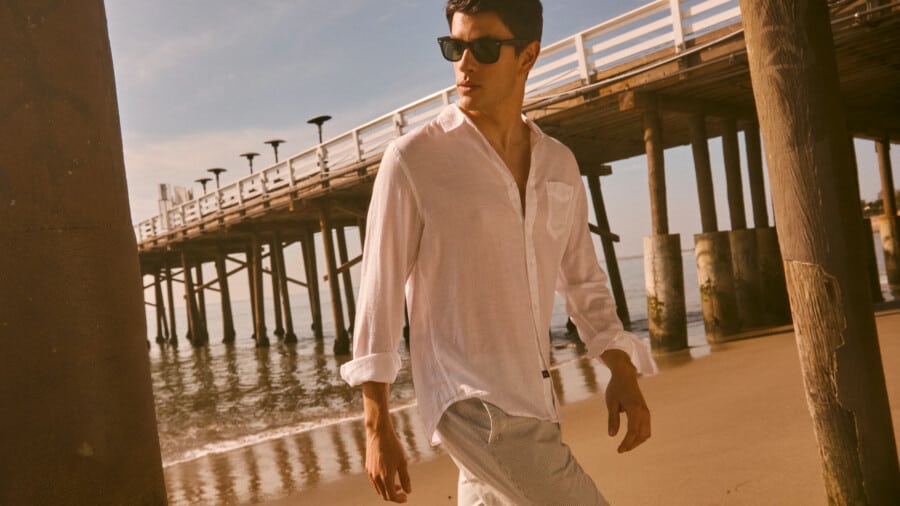
For example, I have no equivalent objection to t-shirts or polo shirts; in the right context they are not only acceptable but also attractive. The display of bicep, elbow and forearm does not repulse me. In a sporting or casual context, the casual shirt does not cause offence. It is when the short sleeve appears in the office that it does cause offence; a weak, thin cotton thing with a pocket stuffed with pens, large airy arms and a stiff but rather characterless collar. Usually worn with unpressed Farah trousers by a portly IT technician who couldn’t care less about the brown sauce stains on his crotch or the dandruff in his hair: however positively you might think of the short sleeve shirt, it has these connotations.
The trouble with this design is that it hasn’t been thought through. It is simply a long sleeved shirt with chopped sleeves. As such, even a slim fitting version creates a bizarre effect; the torso is tight and yet the sleeves flap around like Texan flags. As such, the ‘business’ short sleeved shirt is not to be encouraged. But what of other contexts for the style? What of casual wear, summer parties, dinners on the terrace, cocktails in the Caribbean?
My research turned to that odd chrome-edged style decade, the 1950s. Marooned between the starched collars and wool of the 30s and 40s and the psychedelic colours and nylon of the 60s and 70s, the middle decade has sometimes been thought of as little more than a stop gap between the old order and the new. Personally, I have always thought of the 1950s as one of the most glamourous of decades, despite the Korean conflict and the continued economic hangover from the Second World War.
It had Grace Kelly, Audrey Hepburn, Marcello Mastroianni, Ella Fitzgerald and Jackson Pollock. It was Hitchcock movies, Cary Grant, Marilyn Monroe and the renaissance of Sinatra’s career. It had more tasteful and lasting lustre than the last two decades of the century combined and it was an era in which America’s loudly trumpeted values, art and culture found applaud and approval overseas.
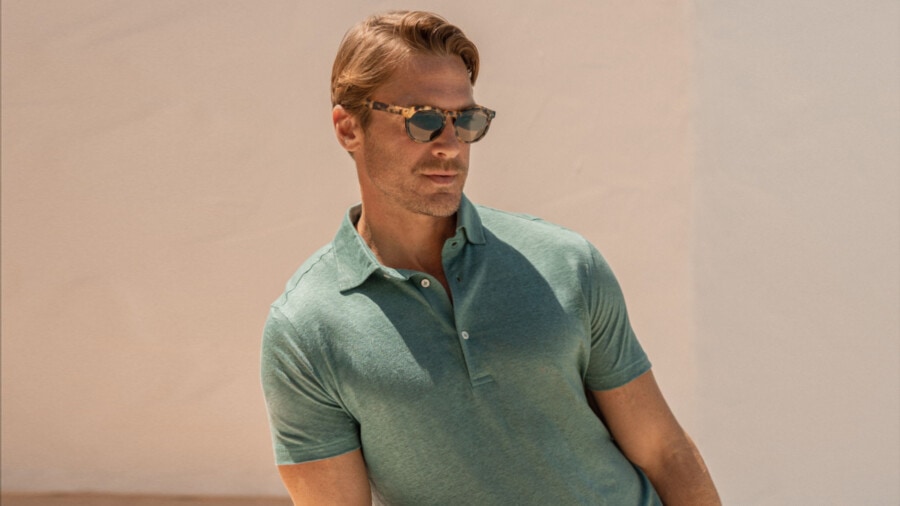
It was also the decade of the American bowling alley, a rather less glamourous but equally important factor in the make-up of the era. And along with the boom of bowling came the unavoidable popularity of the bowling shirt; a brightly coloured short-sleeved shirt that offered sufficient room for the manoeuvres of the sport. The proportions of the shirt were not only practical, but attractive; retailers cottoned on to the trend and soon the bowling-inspired shirt was everywhere. The collar was flat, to the body of the shirt, unlike modern short sleeved shirts which attempt to replicate the structure of a shirt designed to be worn with neckwear. It was intentionally, rather than accidentally, casual.
The only issue with this shirt is that it tends not to suit the trouser styles of today. Partnered with some pleated golfing shorts or smart slacks (worn on the waist rather than the hips) it is both relaxed and chic; with sloppy denim and cargo shorts, it looks completely wrong. This is perhaps why modern variations on the bowling shirt, the craze of the 1950s, tend to be worn by those of older years. At all costs, avoid the putrid Rockabilly versions.
The Velvet Bow Tie

The duty of wearing black tie is avoiding individualism; refinement is permitted, adornment ill-advised. Most men are not interested in adornment, so the act of wearing what every other man is wearing is actually rather comforting to the majority. As fussy and funny as the ‘t-shirt and shorts’ man might think black tie, when he sees everyone else is so attired, he relaxes into the evening, safe in the knowledge that the oddity he frowned upon in the mirror is not alone.
Other men, the ones who relish black tie, often find it rather frustrating that they have such little room for experimentation. Custom warns against ‘peacocking’ and so they find themselves, however more elegantly cut, in the same attire as every other Tom, Dick and Harry; wool dinner suit, white cotton shirt, black silk bow. A rogue pocket square is a temptation, but so often regretted and though buttonholes are an addition frequently neglected by the majority, many well-dressed men are still reluctant to employ them. One friend ‘dissed’ my red carnation and informed me that a modern James Bond “would never wear a flower.”
The choices for subtle individuality are slim. A stiff shirt with a detachable stiff collar is certainly an option but it’s bothersome and takes practice and patience. A creamy white jacket isn’t as smart or as practical as black or midnight blue, and many consider it ‘out of context’ if deployed away from Glyndebourne or the Riviera. Waistcoats are useful, but a no-go in the warmer months and they are increasing in popularity, threatening their status as a choice for the ‘individualist.’ I think both patent Oxfords and pumps are wonderful; still surprisingly rare and very elegant. However, many graceful and frustrated gentleman already own a pair or two and are seeking something different, something more unusual which will mark them as a man of thought and subtlety.
Bring forth the velvet bow tie. Shocking? No. Brave? No. Unusual? Certainly; however ordinary the idea of a velvet bow tie seems, you would be hard pushed to find another at the same event. It has a mildly foppish quality, something between Austin Powers and David Niven, and it offers an alternative texture and structure to silk, contrasting perfectly with one’s lapels. It’s also ever so slightly naughty; the velvet bow tie man is certainly not a ‘stiff in a suit.’ There is a faint and attractive hint of scandal about him; he has seen things, done things – but of those things, no one dares speak. He might be tempted to pair his bow with a ‘waterfall’ pocket-square but this would hamper his underlying masculinity; a simple puff of creamy silk will suffice.
The hell of it is, the self-tie velvet bow, the answer to the ‘subtle individualist’s’ black tie prayers is, rather fittingly, a devil to find.
The Cutaway Tuxedo

Recently browsing a collection of vintage sartorial illustrations, I was caught by an interesting and attractive ‘suggestion’; the scene (pictured above) is the deck of some vacation steamer or private yacht, two gentlemen in evening clothes are about to settle down to a pre or post-prandial beverage. One gentleman has already placed himself in a wicker armchair by a laid table, a hound at his side. The other stands in wait as the crew ready his chair; white shoed and trousered, he wears a double-breasted shawl collared dinner jacket with an attractive equestrian-style cutaway. It is an instantly arresting style; partly because it is unusual but also because it is an approach that worked so distractingly well.
Double breasted dinner jackets are appealing to me, but I was always concerned that they looked slightly too conventional – a black version of a day suit – to be something worthy of ‘evening dress.’ Secondly, the single breasted peaked or shawl lapels, though handsome with a waistcoat, are also rather ordinary and too similar to their daywear cousins in shape and style. This jacket design is fabulous; the proportions are perfect and it is completely idiosyncratic. The cutaway is the defining thing; were it merely a two button double-breasted shawl-collared evening jacket it would be simply unusual. As a cutaway jacket it is unique.
Naturally when one salivates over such items of beauty, it is important to be rational. There is no doubt a tailor could, and would, make such an item. They might choke a little in surprise, and shake their head in dismay as you summarily dismiss the house-styles, but it isn’t a pattern offensive to tailoring. However, should they be ballsy and sufficiently opinionated, they might suggest a couple of reasons why it should not be made:
(a) “The only reason it looks good is ‘cause he’s wearing it with white trousers.”
This is a good point. The argument being that the scalloped look works best when a contrasting colour is involved. Most gentlemen will wear trousers of the same colour and the effect of the cutaway jacket will not be quite the same.
(b) “You won’t be able to wear it open, which means you won’t be able to show off your waistcoat.”
The jacket is of such a design that, worn open, it would look floppy and inelegant. It could only be worn buttoned. For some, this is not a problem as they would only seek to present an aesthetic ideal. Others prefer functionality in their clothing, however beautiful it is, and would shirk from spending money on bespoke for something that can only be worn one way.
Despite these protestations of our hypothetical tailor, personally I think it is splendid. I concede that with matching trousers, the jacket would not have quite the effect it has in the picture and that we are talking about a drawing of pen and ink, not a manufactured example. However, though the cutaway is the clincher, it has other qualities which recommend it as an option for a discerning gentleman; double breasted shawl collars are uncommon, particularly with two buttons, and it has a relaxed, smoking-jacket profile. It might not fully replace the three-piece tuxedo but for something different? For a really interesting item of design and individuality that still manages to conform to the regulations of evening dress? It deserves consideration.
Sartorial Love/Hate: Shoulder Tie

Preppyism, that smart, collegiate and usually colourful attire, is one of the most enduring and yet one of the most vilified forms of dress. For though it finds back slaps, handshakes and approving bonhomie in the boardrooms of the bankers, the bars of the elite and the gin-palaces of the mighty, it is scorned and spited by the proles. Avril Lavigne, that kohl eyed poker-haired teen ‘rocker’, exemplified the ‘popular’ approach to preppyism in her song ‘Complicated’; “Laugh out when you strike a pose/Take off all your preppy clothes.”
Other popular culture has been no kinder to this manner of dress. In Igby Goes Down, Cruel Intentions, Wedding Crashers and just about any other film where the wealthy American elite are subjected to being a morally justified punching bag by the towering hypocrisy of Hollywood, preppy clothes are represented as the attire of evil, the SS uniform of today.
It is little surprise then that this hatred of prep has infected British culture too. The popcorn-munchers, nodding along to the subversive drivel onscreen, have clearly had their taste affected; a female friend of a friend asked me rather awkwardly why I dress as though I live on the Upper East Side; “Have you been inspired by Chuck Bass?” she asked pityingly. Although I informed her rather dismissively that I was wearing bow ties before Bass was even a scribble on a storyboard, I noted a tinge of disapproval too. Preppyism is apparently the act of appearing wealthy; at its baser end it means the donning of labels and logos – particularly Ralph Lauren – and at the more sophisticated end, the sort of styling that belongs at a mid-20th century Ivy League college. Either way, detractors state that it is an affectation to appear wealthier than one is.
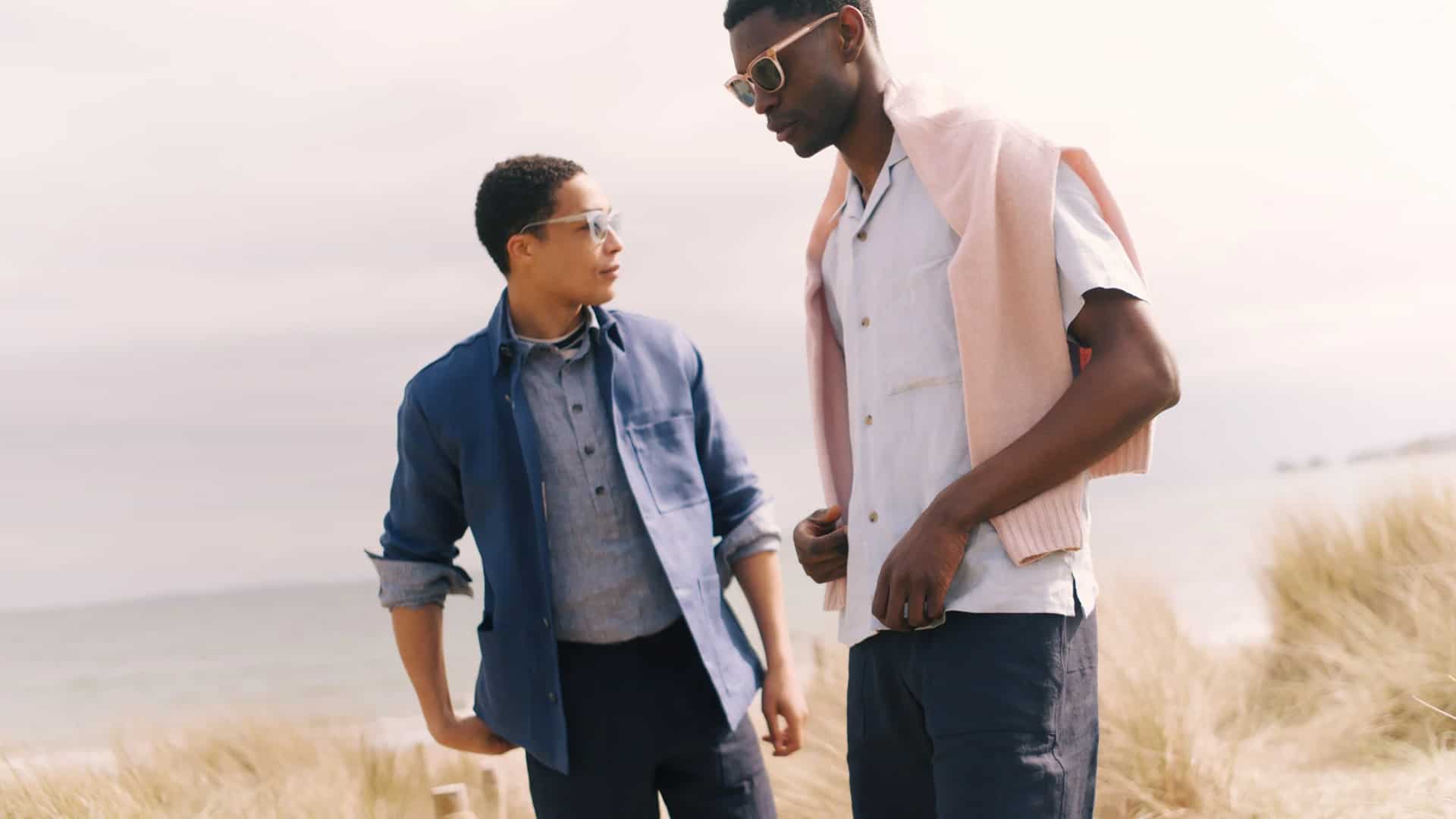
One of the flying standards of preppyism is the classic, and often pilloried, jumper-tied-around-the-shoulders. This affectation is one of the trademarks of the preppy look and its deployment causes ridicule as well as raucous WASPish applause. Practically, it makes sense. It may well be too warm for a jumper in the afternoon but by the time twilight sets in, a chill could descend. It is difficult therefore for anyone to begrudge the use of a jumper. However, is a gentleman justified in wearing it tied over his shoulders rather than anywhere else on his body? Couldn’t he just carry it with him, or fold it in a bag?
Firstly, let us consider the other popular options. He could wear it tied around his waist although this is inelegant and impractical; the kilt-ish jumper would get creased and crumpled from being sat on, not to mention the possibility of attracting dirt and grime. Also the associations of this practice (football hooligans, louts) are far worse than anything the shoulder-tie could muster. It could of course be carried, although this would leave only one hand free; not a happy situation when two hands are required. It could be carried in a separate bag although this would only be convenient if the bag was required for some other purpose.
The problem people have is not with the practicality but the image it conveys; if not a ‘detestable’ member of the upper-echelons, a poor parvenu. It looks pretentious in certain contexts and, rather unfortunately, is a habit that has been adopted, at least in my own circles, by some of the more snobbish and vindictive of people. There is certainly an exaggeration and caricature of the practice and it is arguable that Hollywood’s representation of ‘evil snobs’ in the attire would necessarily attract those who consider it a badge of honour to be such a character. However, each man has his own experience of the shoulder-tie – I have no especial dislike of the practice, and have found my own shoulders useful on a changeable summer’s day – but there are those who avoid it, lest they should be associated with the ‘set’ which flaunts the ‘uniform.’
Brand Review: Viyella

In a little wooded valley in Derbyshire, a neglected building looms over a pond. It’s regimented spacing of small windows, uneventful façade and perfunctory annexes convey the unremarkable; another forgotten mill.
However this old mill is located in one of the most famous valleys of the county, the Via Gellia. A somewhat grandiloquent name for so ordinary a valley, this Latinesque pomposity was nevertheless an inspiration for the name of one of fashion’s most important fabrics and one of it’s latest victims; Viyella.
In the late 19th century, William Hollins & Company created of a blend of cotton and merino wool. The twill weave cotton/wool combination was more resistant to shrinkage than the pure wool alternative. It was lighter than wool, yet somehow as warm and more practical. It was an instant hit and soon after it’s creation the “first branded fabric in the world,” ‘Viyella’ was being shipped around the world.
The fabric’s popularity waxed and waned throughout the 20th century but generally followed a downward trend as the years wore on. Increased interest in the fabric in the 1980s, ignited by demand from brands such as Laura Ashley, led to a mini-Renaissance. However this peak was short lived; the newly built factory in Lancashire was to be demolished less than twenty years later. A little over one hundred years after it’s creation, the Viyella fabric is no longer offered for sale. All that remains is the clothing brand which was built on it’s success.
Sadly, Viyella International is no longer an independent concern. What was once one of the largest textile businesses in the UK was humbled by a series of unremarkable changes of ownership. Brand Viyella was first sold in 2003 as part of the holding company’s restructuring to an entrepreneur as part of a measly £1 deal. It was sold on to a venture capitalist and went into administration six years later when it was ‘rescued’ by the not-exactly-healthy Austin Reed.
A little over a year later, Viyella under Austin Reed’s stewardship is offering an appropriate glimpse of a yesterday world of substantial fabrics, solid craftsmanship and traditional British aesthetics. Tartan ties, tweed jackets, coloured socks accented by the head of a stag (Viyella’s logo), the collection is certainly of heritage style but what it offers in aesthetic it fails in range and marketing. These brands-within-a-brand rarely work and as it comes to the middle of the summer sale, the Viyella racks on Regent Street are still creaking with stock.
Unlike successful retailers of crusty British attire Hackett, Viyella-from-Austin Reed is half done; Hackett woos you with a more complete range, style inspiration points from romantic imagery, classic film and rose-tinted visions of Edwardian England. It grabs you and holds you. You want to be a part of it; it encapsulates an entire lifestyle.
No one knows who the Viyella man is. He has a strong history, stronger than the fledgling Hackett, but he obscures this enviable provenance within a store known more for it’s increasing mediocrity. The fabric is no longer relevant and no longer wanted but the brand needs to be trumpeted; this is our history, this was our mill, we sold fabric to the entire English speaking world. Doubters say that Viyella was merely a mill. Really? Well then, Gucci was merely a saddler.
• Ruffs, Cuffs and Farthingales (by Winston Chesterfield)
• BespokeMe (by Andrew Williams)
• Simply Refined (by Stephen Pulvirent)
• A Southern Gentleman (by Andrew Hodges)
• Smarter Style (by Michael Snytkin)
- Ivan: I’m currently a medical student...
- Rico: I’ll have to disagree with Jim....
- foolio iglesias: Hey,it’s well known...
- Harry: Congratulations! And a fine outfit...
- Harry: Braces are almost inevitably provide...