
The Striped Suit

“Oh yea, pinstripe suits are the best!” grinned the giggly girl in the café as her male companion reluctantly twirled around in a shiny two-piece. Notched lapels, two buttons, wide white stripes – more chalk than pin – and a garishly blue sheen, it was a spectacle suit; not exactly to my taste but still challenging and rather outrageous. My companion, a fellow eavesdropper, remarked with approval and asked for my opinion, which was, I informed him, that the stripes were a little too wide and white for my taste and that the distance between them too great.
On our wander around the neighbourhood, we passed a mannequined window displaying more than one example of striped suits. One was a double breasted example, classically chalked creamy stripe on a dark grey background, medium gauge – the sort of thing Jay Gatsby might have worn. The other was a very narrow gauge grey pinstripe on a navy background. Single breasted with ubiquitous notched lapels it looked decidedly modern. My companion remarked that a ‘blind buy’ of a striped suit was evidently impossible; you’ll never be quite sure of what you are getting.
Rather reactionary and hasty fashion writers have written off striped suits as twentieth century relics. The followers of such folly have agreed to the reasoning that they are only appropriate for the now terribly unfashionable City banker or the East End-born Capone wannabe, neither of which are characters sufficiently savoury for fashion leadership.
I myself scoff at such myopic analysis; the stripe is foremost an expression of style, not position or social class. The stripe knows no century or decade in which it must be imprisoned. The manacled confinement in which it finds itself, loathed for its associations and ignored for its aesthetic, is entirely the fault of fashion-centric witch hunters; out to sound the death knell for as many of the 57 varieties as possible. As the gushing young female in the café proved, there are too many admirers of stripes for them to be truly buried and forgotten.
However, the stripe gang has definite leaders. And, though stripes certainly cross social and professional boundaries, there are strong associations with certain types that simply cannot be ignored.
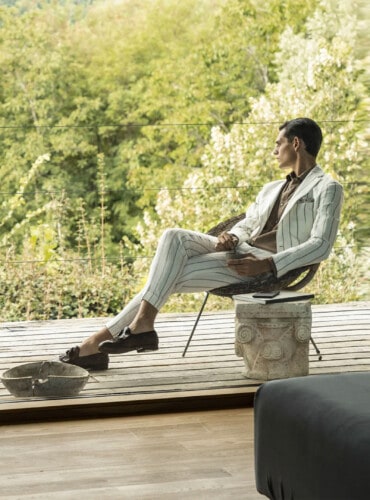
Pins and chalks of a half-inch gauge are the classic. Fabulous in double breasted format, or perhaps single breasted with peaked lapels and a waistcoat, this style of stripe is understated and timeless. A standard tailoring stripe, this is seen on many proponents of the classic English suit. This is the stripe I would prefer.
Stripes of three-quarter inch or full inch gauge are rather more brash and garish; retro gangsters, rappers and wide boys enjoy the punch and the arresting drama of this rather unsubtle choice. They are often worn thickly on black cloth rather than blue or grey which accentuates, somewhat uncomfortably in my view, the dazzling effect.
Stripes that are of a quarter-inch gauge or less are odd but certainly less outrageous and make the suit appear, due to the compression of colour – a result of the narrow gauge – ‘unstriped’ from a distance. This is a style of stripe that is becoming ever more popular.
When selecting striped suits off the rack, make sure the stripes match at the seams. There is something rather saddening about a bright chalk stripe that fails to do so. In terms of shirt and tie choice, plains are the best background for loud stripes – in other words, let your suit do the talking. A little paisley pocket square would always be welcome. Bright colours work very well with striped suits, particularly pink and lilac. As popular as the aggressively contrasting stripe suits are – black with white stripes - I think the most stylish option is light grey stripes on a dark grey background. A sky blue shirt with a burgundy tie, and possibly a white pocket square, completes this traditional look.
Leave a Comment
Summer Striped Ties

Summer is upon us. And though this means many gentlemen will be looking to shed clothing, some of the best ways to celebrate summer are by accessorising; belts, pocket squares and ties come to the fore in summer outfits. The candy pink handkerchief that looked so outrageous in January, suddenly looks essential in mid July. The Hermes-orange belt that prompted concerned faces in the winter rain turns admiring heads in the summer sun; letting the bijoux items in your accessories shine adds a special summertime character to otherwise rather regular ensembles. One of the most potent ways of exploiting the gaiety, the frivolity, the champagne-cork-pop levity of summer is by wearing striped ties. Stripes are fun indeed; they are the big top marquee, the straw boater band and the summer dress. And the bolder the better.
Of course, there is the sober, clubby and, if you like, stuffy side to striped ties. The members of the club; the Old School; the Oxbridge college men and the regiment. However, it is partly because of such associations that the striped tie is a sought after fashion accessory at all. It’s de rigeur to wear a striped tie at Henley, even if you think a boat club is a nightspot in St Tropez and, other old ‘season’ events like Wimbledon, Guards polo and the Lords Test Match have men of all ages bumbling along, sipping champagne and clapping ferociously - in a striped tie.
Good stripes vs Bad stripes
However, as my fellow contributor Simon Crompton pointed out in his article on shirt stripes – there are good stripes, and bad stripes. The ‘Islington Media Type’ shirt stripe is utterly passé. And, conveniently enough, so is the tie equivalent. The different width stripe works, but not in this illogical and overdone format. It works when there are fewer stripe colours and variations; there is more order, and it is pleasing, even soothing, to look at so calm a pattern. Some regimental ties have stripes such as this. The ‘Islington’ tie is however, a messy abomination.
Simple colour combinations, simple striping
I am not always a believer in the cliché that simpler is always better but when it comes to striped ties, I rather am. Four colours on a tie really are quite enough. Dark blue, green and red ties are the best backgrounds for paler stripes and the best combinations are navy and white, navy and red, navy and sky blue and navy and green – honest, simple and punchy ties that stand out from a distance.
Horizontal stripes
As always, I am keen on promoting individualism. Most ties are of a diagonal stripe – which would be disastrous on a shirt, but is fine when confined to the narrowness of a tie. However, there are a few horizontally striped ties, with flat ends, that are around. They are generally of a knitted silk and are most often double-coloured. There is something slightly stagey, and even continental about the horizontal stripe tie; it was popular for a while in the 1930s and again in the 1950s and is now making another rather understated reappearance.
Leave a Comment
Summer Black Tie

A reader of my blog wrote to me recently requesting advice on a particular matter. It was, he wrote, an issue of confusion. He had received an invitation to an engagement party that stipulated ‘Summer Black Tie.’ Naturally, the reader had since concerned himself with determining exactly what this entailed. He had, in his own words, come rather unstuck. He had looked elsewhere online but had become even more confused by the polar sermonising of traditionalists and fashionistas.
Apparently, GQ Online has produced a guide for gentlemen intrigued by the notion of the summertime tuxedo. The first point of advice? “…Skip the tie, unbutton your collar, and add a simple white pocket square.” I stopped reading at that point and returned immediately to my work. Anything that advocates the abandonment of the tie in formal dress is not worth the cyberspace it’s written in. This is not a Tom Ford lookalike competition. Not wearing a bow tie, irrespective of the temperature, is lazy. This is not a question of ‘different taste’ it is simply a question of taste – having it, or having none at all. A hairy chest is not an acceptable replacement for elegant matte silk. Why should the women be forced to socialise with an underdressed man?
My own advice to this reader was rather different. Whereas GQ seemed to be promoting the shedding of bows, powder blue shirts, khaki suits and denim (yes, denim), I suggested to the inquisitive visitor that above all, his evening dress must acknowledge the formality of the occasion, the location of the occasion and, of course, the season. After all, it was an invitation stipulation. Unfortunately for the ultra-traditionalists, those who eschew cummerbunds in the heat of summer, this means that some allowances have to be made. We no longer, thankfully, live in an age where those who wear formal dress endure heat and discomfort for the purposes of ‘prestige’ – indeed, the accounts of colonials in Burma, Egypt and other exotic outposts of empire suggest that this was a mask of propriety and ‘civilisation’ that caused the stiffest of upper lips to wobble.
Now that our lips are permitted to do as they please, there is nothing wrong with a little climate preparation in attire. Some suggest the off-white jacket as an alternative. Some even suggest a mess jacket.
The former is more common and, although it is known as the ‘cruise’ jacket, is appropriate for summer invitations such as garden parties. It should always be shawl collared. Opinion is divided as to their proper use. Many say they are only appropriate outside of the metropolis – like the straw boater. Others suggest that times have moved on and the summer aesthetic and tradition of the off-white jacket is more important.
The mess jacket is rather frowned upon, although such a reaction has never bothered me. Those who wear one may be subject to tongue-in-cheek comments and whispers behind the napkins. Known as bum-freezers, mess jackets are tailless tailcoats; with peaked or shawl lapels, they are exceptionally smart but very rare.
I believe that the anchor for all black tie outfits – summer or winter – is a formal white shirt and black, or midnight blue, evening trousers. These are constants. They cannot be altered. The idea of facing the lapels of a khaki suit with satin in order to make it a ‘tuxedo’ is abhorrent. It is a khaki suit. It will never be elevated from that humble position. Likewise, adding white trousers to a dark jacket makes it a day outfit – not an evening one. However, adding a seersucker jacket to black evening trousers, a well ironed white evening shirt, a black bow tie and black patent shoes is acceptable. The acknowledgement of formality is in what is beneath the jacket – the nod to climate, season, and perhaps locality, is all in the jacket itself.
Leave a Comment
Shirt Review: Cad & The Dandy

One of the best things about made to measure clothing is the wait one has to inevitably endure until the item is available for collection. The immediate satisfaction of ready-to-wear clothing is short lived; the anticipation, the stroll up to the cash desk, and the slideshow of potential uses running through the mind, are exciting moments. However, as soon as the plastic has been swiped, the thrill subsides. It’s the waiting that makes it worthwhile. Waiting, in today’s world, is rather a novelty. We fly to places our ancestors endured weeks to travel to; we no longer expect communication to take more than a second through email; we microwave; we broadband; diets and exercise routines are fast, fast, fast. And in the midst of all this speed, it is strangely satisfying indeed to know that craft does, and will always, take time.
Cad & The Dandy, who made my superb double-breasted suit, offer a mixture of the new and the old; the craft and the speed. Although it still takes time for items to be made, the system of ordering is remarkably easy and very quick. Once your measurements have been taken, they are stored on your online account – to order more takes a few simple clicks of the mouse. So to order a shirt, all that was needed was a little use of the ‘design’ tool, a few more clicks and the order was complete. When it came to the exciting day of ‘collection’, the anticipation that had been building – mixed with a little trepidation as the shirt design was unusual – reached a high point. When I saw the shirt, this gave way to a sense of relief and satisfaction. Not only had I received a shirt cut correctly to my juvenile, awkward shape but also a shirt of a design for which I had searched high and low; horizontal stripes.
Horizontally striped shirts are near unicorn; they are almost never seen. I once spoke to a rather aloof assistant on Jermyn Street of them, of how interesting and attractive I thought them, and of my vain search for one. “Well” he scoffed “that’s probably because vertical stripes look infinitely better.” When I asked him whether he had seen one he responded in the negative claiming that it was probably a fad, an illogical foray into “being different for the sake of it.” I suggested to him it was the shirting equivalent of unbuttoned suit cuffs as it is more expensive to use striped material horizontally. He laughed derisively and attempted to persuade me to purchase a butcher stripe. Fortunately, though you won’t find them on Jermyn Street (or any other street for that matter), it is possible to twist a tailors arm into making you one. And, from my experience of the quality and the aesthetic of the result, I am rather rueful that I haven’t taken up the opportunity of made-to-measure shirts before.
Apart from the fact that Cad & The Dandy have thousands of fabrics to choose from, and countless configurations – yokes, collar types, placket types etc – the enduring appeal of such shirts is that they fit so extraordinarily well. Though off the rack shirts are of a high quality, they often have folds of material that I need to squeeze into my trousers and hide behind my waistcoat. It’s a depressing feeling that my gigantic collection of Jermyn Street shirts, though wonderful, has been comprehensively outshined by the new arrival. The arms, although I have been satisfied with them until now, feel unnecessarily baggy; even the sides of my slim-fit shirts are inches away from my body. And yet it is very pleasing that the shirt that I received is exactly the shirt I envisaged in my time of anticipation. “If this is going to happen” I told myself “it’s going to be something special.” The pattern matching is of a very high standard – a covered placket means that the horizontal lines are not broken at all by the buttons. Even the shirttails are well finished with rounded edges, complementing the club collar and cuffs perfectly. A friend of mine, considerably well-heeled, switched to made-to-measure shirts after leaving school. I consulted him about my excitement and his experiences. “In many ways” he told me “I don’t regret it at all – I feel and look better because of them. If I should lose everything, I’ll rue the day I thought I was grand enough to start.” I asked him whether there was any turning back, once you had started. His response; “None. Frankly, you’re doomed.”
Leave a Comment
Style Icon: Michael Jackson

In the last few weeks, about one particular person, there have been written such headlines, obituaries, paragraphs, bloglines, Tweets and tributes that, if piled all together in some mausoleum of dedication, would surely be visible from space. Superlatives have been exhausted; the end of an era has been marked. Michael Jackson’s passing has dominated the thoughts of all from the breakfast to the boardroom table. Of his status as an entertainer, much has been said. Of his unconventional childhood, much has been lamented. He has been praised and pitied; scorned and celebrated. An awesome showman, he could write and produce his own music; he danced like no other, inspiring a generation of Jackson-lite dancers. He was equipped with a unique voice, a taste for fantasy and an enduring Peter Pan personality.
What has received less mention is Jackson’s very evident, somewhat controversial, taste in clothing. By some he is cited as the last example of extrovert dandyism; in whatever theme of clothing he currently favoured whether it be creamy fedoras, glittering socks, diamante gloves, Napoleonic tunics, wing collars or sequinned blazers. Jackson dressed like no one else. In many ways his extravagance was a renaissance of fashion showmanship unseen in centuries. For while it was undoubtedly idiosyncratic, it was actually well conceived. To some it was predictably vulgar, but to many it was an appealing extension of the Jackson aesthetic; a taste that embraced antiques, classic cinema, exotic animal pets, theme parks and history. He was evidently a curious and eager materialist who found delight in the sort of bauble and bangle that the most outrageous fop would question. But it was not only a willingness to wear what others might not wear; Jackson’s wardrobe was a premier example of personal couture. If Mr Jackson had the taste for a suit of armour, Mr Jackson would get a suit of armour. Indeed, when interviewed, Jackson’s costume designers, in acknowledging that Jackson never wore the same thing twice, indicated that Jackson was always the final arbiter on his clothing choices. But he was not simply an isolated fantasist. Jackson even had method to his adoption of faux-regimental clothing, considering that they ‘demanded attention’ had ‘clean lines’ and ‘fit…almost like dance clothes.’
It was not only that Jackson created his own unique wardrobe. He also, due to his magnificent fame, manipulated the mindset of a generation. I remember adopting some of Jackson’s milder clothing curiosities, a small trilby or penny loafer, and receiving my fair share of the humdrum commentary; “Look, it’s Jacko”, “Hey, MJ!”, “Ow!” For as much as penny loafers belong to a generation of Ivy Leaguers, for many younger people they are the stage-shoe of the King of Pop, and try as contemporary celebrities might to consistently adopt fedoras into their everyday headgear, they cannot shake off the glitter of mid-career Michael.
Some outfits of his in particular stand strong in the memory. The Billie Jean outfit, throughout the years of stage performance, remained roughly the same; a simple white t-shirt, skinny black trousers, a black trilby, black loafers and importantly, white diamante socks and a black sequinned jacket. A stage look, no doubt but wonderfully effective; the eye followed the gleaming socks in the moonwalk, the trilby was a clever prop. And as stagey as it appears, Jackson actually adopted more outrageous ensembles.
On a visit to the Reagan White House, Jackson was auspiciously centre stage. With a white wing collar shirt, black trousers, trademark white socks and opera pumps Jackson wore a museum-worthy creation half cartoon, half regimental elegance; a glittering blue mess jacket with light blue-edged lapels, dazzling gold epaulettes, gold sash and gold buttons – on his right hand he wore the legendary white sequinned glove. Such brazen pomp had probably never before been seen at the White House. As bizarre as the costume sounds, Jackson cut a marvellous, and extraordinarily gilded, figure; striding out onto the lawn between Reagan and his wife. For others, it would be impossible to imitate – for Jackson it was natural.
The one outfit that I remember, as a child, I ached to imitate was the creamy, faintly pin-striped suit from ‘Smooth Criminal.’ With a blue satin silk shirt, cream knit tie, spats and white fedora it was practically a parody of the gangster element which Jackson’s video highlighted. And yet it was simply the most wonderful thing I had seen. It wasn’t the white knight poetry of it, the obsession with Jackson himself or even the fact that I adored the song; Jackson simply dazzled.
Leave a Comment
• Ruffs, Cuffs and Farthingales (by Winston Chesterfield)
• BespokeMe (by Andrew Williams)
• Smarter Style (by Michael Snytkin)
- Robert: Seth is right, you do not loose...
- seth: NYT was on heat loss not hats.
- seth: It’s a myth that you lose most...
- Winston Chesterfield: Gary, Dune still have...
- Andy in Tokyo: I’m a big fan of the...