Web Men's Flair  


Reader Question: Working In A Bank

September 21, 2009 (3 Comments)

gordon-gecko-bankSim, Oxford: I was wondering if you could assist me with your experience regarding sartorial issues, the yays or nays, within banking. I have heard from fellow interns that French-cuff shirts and heavy pinstriped suits should never be worn as they depict status, status an intern does not yet have, and are thus considered a faux-pas by people higher up the chain. Any truth in this and if so, any particular things to avoid?

I think the general guidelines on discretion guided by propriety, and to an extent the dignity of business, should be enough here Sim. It’s just that bankers get a bit more snippy and competitive about it.

If you’re going for a job interview, everyone knows you should be well dressed and smart without standing out. The same thing applies to your first job – or in this case your first internship. Dress as smartly or smarter than your superiors and wear nothing that draws attention.

So I would advise you to wear navy and grey suits, shirts that are white, blue or a blue stripes, and ties that are solid colours or simple stripes/geometric patterns. Wear expensive suits if you have them, equally nice shirts and ties. But keep them sober, and finish it off with a nice pair of black Oxfords.

Avoid: braces, handkerchiefs, waistcoats, double-breasted jackets, trouser cuffs, bright socks, contrast collar or cuffs, ‘humorous’ ties, ‘humorous’ cufflinks, ‘fashion’ suits, and strong colours and strong stripes everywhere. They will all draw attention to your clothes rather than yourself, which is certainly not the aim of an internship.

The reason that some of these items of clothing become status symbols among bankers is that they are often flash and always competitive. Wearing a big, bold pinstripe suit is a way to demonstrate that you can get away with wearing it. Because you have attained such a level of success that it cannot be dented by wearing tasteless clothes.

While it is true that some of these items of clothing are more traditional and hark back to earlier days of banking, it is unlikely that this is the reason they are being worn. There will be exceptions, but these are often men over 50 who actually remember when most colleagues wore braces and white collars.

I would have thought French cuffs would have been alright, though, if all other advice is followed. It can be your little indulgence.


Leave a Comment


This Season I Shall Mostly Be Wearing…

September 10, 2009 (Comments Off)

One of the great differences between men and women when it comes to clothing selections is that whilst women remain keen to keep ‘up to date’; reading fashion bibles, flicking through blogs, gazing at the ensembles of celebrities, fewer and fewer men are at all interested with what the fashion houses are pushing out and more and more seem to be taken with what works; something that has impact. When the seasons change, it is extraordinarily rare for any males of my acquaintance to ask me what is ‘in fashion’ for the coming months. They talk rather of things they’ve ‘always wanted to own’; a particular style of coat or shoe perhaps. Most acquisitions are not in pursuit of a fashionable aesthetic but part of a slow maturation that lifts them from being mere boys into manhood.

Knitted waistcoats

autumnal-knitted

Knitted waistcoats did feature in a few collections for the coming season but they’re hardly a recent invention. Less formal than some other styles of waistcoat, the knitted waistcoat is warm and comfortable to wear – essentially it is a sleeveless cardigan – and offers a textural difference in suit ensembles. It is also smarter than the V-neck jumper which can look rather bulky underneath suit jackets and blazers and due to it being available in a number of colours, offers good colour matching/contrasting opportunities. This is an ideal garment of comfort and elegance for the colder seasons.

Burgundy

autumnal-burgundy

Although a colour associated with autumn, burgundy is not considered ‘the’ colour of the season. Nevertheless, it is a perfect time of the year to experiment with this attractive tone. It is certainly masculine but has a refined, quietly aristocratic quality that softens greys and blues which can often look harsh in autumns golden light. Burgundy cords look particularly fine with brown brogues and a burgundy waistcoat with a grey flannel suit sounds daring but is actually rather a classic combination. Smaller additions such as a burgundy paisley pocket square or a clubby tie add that touch of the regal. Burgundy is also a wonderful partner for other autumnal colours like forest green, tan and chocolate brown.

Patterned trousers

autumnal-check-trousers

Showing flair is easy in autumn; until winter overcoats cover the resplendent ensembles, there is ample opportunity to enjoy, and experiment with, combinations and accessories. I personally think that autumn is the perfect time of the year to wear odd patterned trousers; hounds-tooth, checks and stripes. Whereas summertime seems to call for lower leg simplicity – cooler, paler colours - the introduction of autumnal winds and the natural ‘fuss’ that comes with dressing for the season seems to call for some variation on pant pattern. A classic Prince of Wales check trouser with a blue blazer or perhaps a blue chalk stripe with a brown hounds-tooth jacket.


Leave a Comment


Turn Back Your (Cotton) Cuffs

September 2, 2009 (8 Comments)

OK, so this is how I came to the earth-shattering style insight alluded to in the title:

most of my ready-to-wear jackets have sleeves that are slightly too long;

most of those jackets are casual as my suit jackets are mostly bespoke;

because they are casual they tend to be of rougher material (cotton, linen);

they are also cheaper jackets for that reason;

so I’ve never paid to have the sleeves shortened (because they are casual and because they are cheaper);

so I end up turning back the ends of the sleeves by an inch or so.

Do you like the quasi-logical approach to this style analysis? Essentially, I realised that I like turning over the end of my sleeves on casual jackets. I like it as a small style quirk, as a little casual but personal touch. But I think it only works with casual jackets because the roughness of the material matches the casual nature of the gesture.

A business suit is usually made of smooth worsted wool because smoother, sleeker clothes are smarter. Smooth cloth goes with crisp creases, high-shine shoes and sharply angled handkerchiefs. Can you feel the aesthetic?

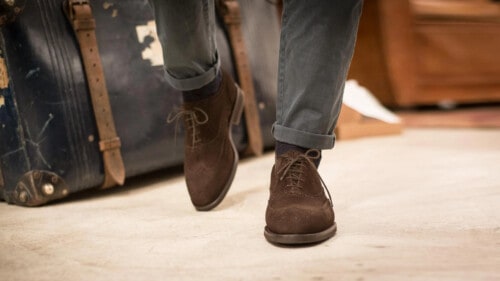
By contrast, linen is rough and ready, goes with crumpled lines and soft woollen ties, faded madder dyes and heavy, seamed shoes (Derbys, brogues, double soles). So turning back your cuffs can work.

If you wanted turned back cuffs on a smoother cloth, they would have to be precisely turned and stitched down – like the cuffs you get on velvet jackets and some overcoats. That is the only turned back cuff that will work because it is exacting, fine and firm.

roll-sean-connery

Of course, you need to be able to physically turn back the cuffs for this theory of mine to apply. So a tweed or heavy wool jacket will not work. This is the exception to the rule, though the rule remains – casual touches will work best with these heavy, rougher jackets. So if you need to do some more manual labour (and the cuffs unfasten) roll back those sleeves and get down to it. It’s what working cuffs were designed for, after all. Makes it easier to clean your hands afterwards as well.

(Interesting how times have changed though. John Hitchcock, managing director at Anderson & Sheppard, confirmed to me recently that the firm used to refuse to make working cuffs. They were the sign of a labouring man. And today they are a sign of quality that even A&S is happy to provide. As John put it, “we’ve always liked to be a little bit different.”)


Leave a Comment


A Step Further In Suit Alterations

August 28, 2009 (Comments Off)

One true hallmark of a bespoke suit is the size of its armholes. Most armholes in ready-to-wear suits (and made-to-measure patterns, to a certain extent) cater for men with larger arms and shoulders, in order to be on the safe side. As with so many other areas of menswear, no one notices when they’re too big, but everyone would notice if they were too small. Smaller armholes are also just harder to make.

As bespoke is cut uniquely for you, the armholes can be as small as you want. And the biggest advantage of small armholes is that the arms can move independently of the body of the jacket, without dragging its chest and back all over the place.

Lift up your arms and see how far the waist button rises (when the jacket is done-up). With a bespoke suit, that movement is vastly reduced. So your collar stays on the back of your neck, your upper body is more consistently shaped by the jacket’s cut, and if you’re Fred Astaire you can dance and wave your arms around while still looking good. (Modern equivalent: it’s much easier to work at a computer for long periods, arms stretched forward.)

This effect is accentuated when a larger sleevehead is eased by hand into that small armhole, as accentuated by tailors such as Anderson & Sheppard and ready-to-wear by brands such as Kiton.

It would be great if a ready-to-wear suit could be altered to have smaller armholes. Unfortunately, it’s not that easy. A smaller armhole means extra material under the sleeve and in the body of the jacket – and most suits don’t supply any extra here.

There is, however, a cheat. If you get your tailor to insert a thin extra shoulder pad into each side of the jacket, it lifts up the armholes and effectively makes them smaller – as the pad at the top is taking up some of that armhole space.

shoulder-pads

The downside is that you have bigger shoulders. But I don’t mind this. As I have sloping shoulders anyway, I tend to ask tailors to build in a slightly heavier shoulder pad. And increasing the padding in a ready-to-wear suit also lifts up the drape of the jacket, removing the folds that collect next to my sleeves in the back (due to those sloping shoulders). So it suits me both ways.

The effect is not the same as a genuinely smaller armhole, of course. The circumference is still the same. But it gets partway there and is certainly an improvement. I wouldn’t recommend it for men with large or square shoulders, and the insert should always be pretty slim, but if you happen to have a similar body type to me, I recommend trying it.


Leave a Comment


Are You Going Out In That

August 26, 2009 (3 Comments)

going-out

I am often asked this question; “What do you wear when you go out?”

Why am I asked such a question? Chiefly, because my particular inclinations (bow ties, paisley pocket squares and fuss) do not seem to marry with the idea of what that particular person considers ‘going out’ clothing. ‘Going out’ is unambiguous code for late night bar-hopping, clubbing, guest list queues and almost any activity past 6 in the evening that involves the purchase and consumption of alcohol and the ‘musical’ assailing of the ears.

For women, ‘going out’ is frankly ceremonial. Hours before departure, dresses are trialled with necklaces, shoes, bags, bracelets and boleros. Make-up is invariably applied, hair remarkably coiffed, skin moisturised and nails shining. Men make no such effort. In fact, men often make no distinction between day wear and evening wear at all. This is largely because the line between the two has blurred considerably, but also because eveningwear used to be so easy for the poor, uninterested male. All he needed was a few white evening shirts, a black bow tie and a dinner suit. He never cultivated alternatives or variations as women did. As stiff and as formal as it sounds, black tie was perfect for the man who didn’t care.

These days, he has the misfortune of choice. The most common dilemma is ‘Which clean shirt shall I wear?’ followed by ‘Which jeans match smell the best?’ For the shirt, usually untucked, worn with jeans is by far the most common ‘going out’ ensemble for men in my neck of the woods. I cannot stand it. It lacks invention. It lacks presence. Although, I admit, it is rather perfect for the environments in which it is often seen – dark, cramped, sweaty clubs that remind me more of a musical Tube ride at rush hour than an MTV video set.

Although I would always encourage a gentleman to wear the clothing he feels most comfortable in, even if this be tweed n’ cords, I always adjust my signature a little when I venture out for a ‘hit’ of nightlife. I tend to tone down; bright clashes of colour that work well in the sunlight have little effect in the gloom of a club. Also, I tend to work with more monochromatic colours – greys, white, black, navy blue – and stay away from brown. Colour and flourish added can be rather simple. Ties, if I wear them, tend to be simpler and stronger in contrast if patterned. If I go without a tie, I invariably add a silk pocket square. Silhouette is always important but at night it is particularly pertinent as less detail is on display; ergo, trousers should be flatteringly slim and jackets short.

I also think playing with texture is more important than playing with colour subtleties; the odd patent belt, velvet jacket or slub-silk trouser adds depth. The best thing is, ‘going out’ clothing is far easier for the male to achieve as so much of it can be borrowed from what is considered to be his ‘work wardrobe.’ For that ease of transition, the male is envied.


Leave a Comment


 Page 4 of 96  « First  ... « 2  3  4  5  6 » ...  Last » 

SUBSCRIBE
Latest Articles Via Email:

Delivered by FeedBurner
RSS Feed

MensFlair Readers

COLUMNS
Permanent Style (by Simon Crompton)
Ruffs, Cuffs and Farthingales (by Winston Chesterfield)
BespokeMe (by Andrew Williams)
Smarter Style (by Michael Snytkin)
SPONSORS
RECENT COMMENTS
POLL
What color of suits you prefer?

Grey
Navy
Black


View results
Archive